A long time ago, my husband told me that all of life's happiness is due to timing. When you do the right thing at the right time, good things happen. After 6 months of planning a winter trip in the Porcupine Mountains, in Michigan's western U.P., it turns out my timing was all wrong. Then again, my timing couldn't have been better.
This pretty much sums up the entire experience of snowshoeing through the Porkies and staying overnight in Yurts during the winter: Extremes.


Another extreme is the level of difficulty I experienced, though this is not true for everyone, including the two young couples I met who bounced over the trails in their snowshoes while I labored with each step. They carried everything they needed in packs that I know were heavy, but seemed not to burden them, while I huffed and puffed and fell down pulling my sled full of so many things I didn't need. Perhaps experience is still the greatest teacher, but youth is the greatest student.
Maybe I wouldn't have struggled so much had my timing been better, but several things were at play. A week before my scheduled trip, my dad had an accident which put him in the hospital where he received frustratingly substandard care. It quickly became obvious to my mom and me that we would be responsible for his care, not the hospital staff. Between making sure Dad was never left alone at the hospital, and running Mom to oncology appointments, and checking in on my 95 year old Grandmother, while trying to keep up with things at home and see my husband and daughter each day, I was exhausted. It was an emotional week as well, and by the time everyone convinced me to go ahead with my trip, which I was ready to cancel, I couldn't think straight or see straight. I was so worn out and tired.
 Then, the day I was scheduled to leave, we got an ice storm. I stayed up late the night before packing my sled and backpack, then started out the next morning. I made it 10 miles out of town on the highway before turning back. The roads were pure ice, and I just couldn't handle the drive on top of everything else. I came home upset, discouraged, and thinking that there were an awful lot of signs that this trip was not meant to be. My husband said to just wait one day, then try again. My dad begged me to go. My sister promised she would take care of things in my absence. So I tried again the next day.
The next morning, school was cancelled. So how do I leave my young daughter home alone all day? A friend called and invited her over. For every sign that said "Don't Go", a solution appeared. I left.
After 8 1/2 hours of driving on icy back roads because the highway was closed, I had made it to Gaylord, about 58 miles south of the Mackinac Bridge. In normal circumstances, I would have reached Gaylord in 3 1/2 hours, but there was nothing normal or even reasonable about that drive. I found a hotel and hunkered down for the night to wait out a blizzard the likes of which I have never experienced. My second day of driving wasn't any better, but I forged ahead and reached the Porcupine Mountains Headquarters with an hour of daylight left.

 Once I had checked in with the Ranger and parked my vehicle at the trail head, all I really wanted to do was curl up in the back seat and sleep for a week. What was I thinking, believing I could handle this winter excursion? I gathered what little strength I had left and pulled it around me in a shroud, and set off on the groomed trail. In about an hour, it would be fully dark, and Bob Wild, Park Naturalist, was busy on the trail filling lanterns with oil and lighting them for the Saturday night lamplit ski. I took great comfort knowing he was close by, because I will admit to being uneasy about pulling my sled alone through the woods. Bob pointed out the ungroomed trail to the Yurt, which I would have missed, and I left the safety of Bob's domain to break a new path, alone, to the Yurt.

It was very cold. I was dressed properly and working hard to pull the sled and navigate the deep snow in my snowshoes, so I stayed warm, but my fingers and toes were cold. It didn't take long to reach the Yurt, and God bless the previous occupants who had left me plenty of split wood for the stove. Inside, I made fire my first priority, as it was just as cold inside the Yurt as it was outside, 8 degrees below zero Fahrenheit. Without removing any layers of winter wear, I unpacked my sled and pack, gathered snow to melt on the stove for water, then stoked the fire up and left to join the lamplit ski tour.
It was dark inside the Yurt, and really dark outside the Yurt. Again asking myself why I was here, I turned on my headlamp and started back the way I came, terrified at every sound until I realized that most of what I was hearing was other people. Other people meant safety.
 Every Saturday night in February, Bob Wild lights the lanterns and people come from all over to ski or snowshoe the lamplit trail to the warming shelter, an outdoor bonfire, and hot chocolate. Some of the people are staying in various shelters throughout the park, while many others come from nearby. I met some amazing people, people who didn't think I was crazy or particularly adventurous to be there alone. They were people like me, who believe that snowshoeing through the Porkies in the winter and staying in a Yurt is just something to do, no big deal. I felt like I belonged. I actually did belong.
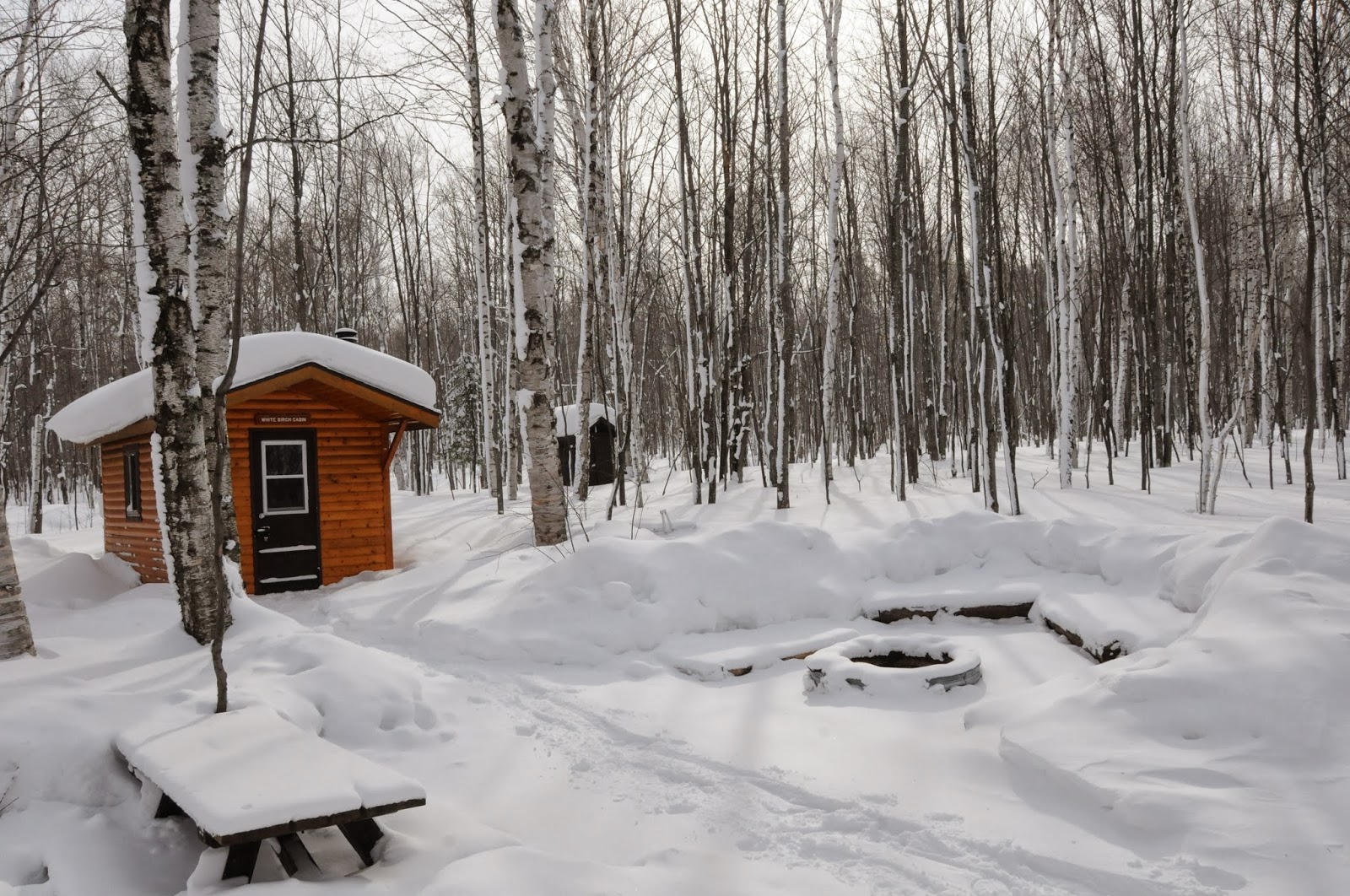
I returned to my Yurt about 10:00pm, this time feeling overwhelmed by the peacefulness of hiking alone down a barely marked trail after dark. I almost went right past the Yurt, I couldn't see it, but I could see millions of stars winking at me, whispering a calm encouragement.
Remember those extremes of which I spoke? Opening the door to the Yurt, I was hit with a forceful blast of heat. Ten minutes later, I was stripped down to my underwear and standing in the open doorway trying to cool off. It was a sauna in there!
I thought that if I kept the fire low in the wood stove, I could reach a comfortable temperature, but that first night I discovered that the Yurt was either stifling hot, or as cold as the outdoors. There simply was no in-between. Reading the Yurt journal, I was pleased to see that all previous hikers complained of the same problem, so at least I wasn't stupid.
I lay there that first night, thinking my timing was all wrong. My parents needed me, I had driven
 through one of the worst blizzards in 20 years, I was exhausted. Many of the tasks required of me called for energy and strength and I struggled to collect firewood that was buried under 4' of snow, carry out my garbage to the bear-proof container, cook outside in subzero temperatures, and snowshoe through the mountains. I did it all, but my limbs were tired and none of it came easy.
 Then again, I was in the Porcupine Mountains in the middle of one of the coldest, snowiest winters ever recorded. You might think this is another item for the "bad timing" list, but this is what actually turned out to be the best timing possible.
How many people can say they walked on Lake Superior two miles from shore? How many people can climb on top of a 6' wave and stand there, only to slide down the back side? How many people will willingly hike for days with the temperature below zero and the 45 mph winds creating a feel of -30 F? It is unusual for Lake Superior to be 90% frozen, and I picked the best winter to experience her in a way few people ever will.


 An awe crept into my days. Awe for Mother Nature, the weather, snow,wind, and bitter cold. Awe for the mountains, blanketed in deep snow, and then Lake Superior, frozen and suddenly reigned in from her fury. There was awe for the fresh kill site in the deer yard, wolf tracks telling the story of life and death. A curious pack of coyotes who came too close to the Yurt inspired me to be brave and trust that these wild animals had no real interest in me. Mostly, though, I had awe of myself. Little ole' me, who has always taken the safe route and lived such a normal life, was here, in a Yurt in the middle of the mountains during a brutal winter, surrounded by coyotes, and unafraid.
With elderly parents, kids, and a husband, it's not the right time for me to be an outdoor adventurer. Yet, I believe the wilderness is pulling me to her, I believe there is a purpose for me that I don't quite understand, and I believe in myself. I can be stronger, smarter, and a better example. I can walk with wolves, stand on a tundra, climb mountains, and use these experiences for something good.
 There is nothing special about me. I am just like you. But if you think you could never snowshoe in the Porcupine Mountains in winter and stay in a Yurt, or if you think you'd never even want to, you are wrong. If I can do it, stumbling and frightened the whole way, you can too, and you should do it at least once, to believe in the balance of our natural world, believe in the role of every human, tree, wild animal, and body of water. Most important, do it to believe in yourself. But don't pull a sled. You really don't need all that stuff!
For more information about winter hiking in the Porcupine Mountains, please visit the Porcupine Mountains Wilderness State Park web page. There you can find information for camping and activities in any season, and some great tips for a winter experience. For a list of what you need to pack, check out REI's Winter Camping Essentials.
This pretty much sums up the entire experience of snowshoeing through the Porkies and staying overnight in Yurts during the winter: Extremes.
It turns out, a winter Yurt only has two temperatures; hot and off.
Winter in the Porkies means you are either surrounded by dense forest, or in the middle of a vast emptiness.
 The terrain is either up, or down. Snow is thigh deep and fluffy, while ice is flat and hard. A gale force wind blows all night, then the sunrise brings an eerie calm. Everything is extreme.
Another extreme is the level of difficulty I experienced, though this is not true for everyone, including the two young couples I met who bounced over the trails in their snowshoes while I labored with each step. They carried everything they needed in packs that I know were heavy, but seemed not to burden them, while I huffed and puffed and fell down pulling my sled full of so many things I didn't need. Perhaps experience is still the greatest teacher, but youth is the greatest student.
Maybe I wouldn't have struggled so much had my timing been better, but several things were at play. A week before my scheduled trip, my dad had an accident which put him in the hospital where he received frustratingly substandard care. It quickly became obvious to my mom and me that we would be responsible for his care, not the hospital staff. Between making sure Dad was never left alone at the hospital, and running Mom to oncology appointments, and checking in on my 95 year old Grandmother, while trying to keep up with things at home and see my husband and daughter each day, I was exhausted. It was an emotional week as well, and by the time everyone convinced me to go ahead with my trip, which I was ready to cancel, I couldn't think straight or see straight. I was so worn out and tired.
Then, the day I was scheduled to leave, we got an ice storm. I stayed up late the night before packing my sled and backpack, then started out the next morning. I made it 10 miles out of town on the highway before turning back. The roads were pure ice, and I just couldn't handle the drive on top of everything else. I came home upset, discouraged, and thinking that there were an awful lot of signs that this trip was not meant to be. My husband said to just wait one day, then try again. My dad begged me to go. My sister promised she would take care of things in my absence. So I tried again the next day.The next morning, school was cancelled. So how do I leave my young daughter home alone all day? A friend called and invited her over. For every sign that said "Don't Go", a solution appeared. I left.
After 8 1/2 hours of driving on icy back roads because the highway was closed, I had made it to Gaylord, about 58 miles south of the Mackinac Bridge. In normal circumstances, I would have reached Gaylord in 3 1/2 hours, but there was nothing normal or even reasonable about that drive. I found a hotel and hunkered down for the night to wait out a blizzard the likes of which I have never experienced. My second day of driving wasn't any better, but I forged ahead and reached the Porcupine Mountains Headquarters with an hour of daylight left.
Once I had checked in with the Ranger and parked my vehicle at the trail head, all I really wanted to do was curl up in the back seat and sleep for a week. What was I thinking, believing I could handle this winter excursion? I gathered what little strength I had left and pulled it around me in a shroud, and set off on the groomed trail. In about an hour, it would be fully dark, and Bob Wild, Park Naturalist, was busy on the trail filling lanterns with oil and lighting them for the Saturday night lamplit ski. I took great comfort knowing he was close by, because I will admit to being uneasy about pulling my sled alone through the woods. Bob pointed out the ungroomed trail to the Yurt, which I would have missed, and I left the safety of Bob's domain to break a new path, alone, to the Yurt. It was very cold. I was dressed properly and working hard to pull the sled and navigate the deep snow in my snowshoes, so I stayed warm, but my fingers and toes were cold. It didn't take long to reach the Yurt, and God bless the previous occupants who had left me plenty of split wood for the stove. Inside, I made fire my first priority, as it was just as cold inside the Yurt as it was outside, 8 degrees below zero Fahrenheit. Without removing any layers of winter wear, I unpacked my sled and pack, gathered snow to melt on the stove for water, then stoked the fire up and left to join the lamplit ski tour.
It was dark inside the Yurt, and really dark outside the Yurt. Again asking myself why I was here, I turned on my headlamp and started back the way I came, terrified at every sound until I realized that most of what I was hearing was other people. Other people meant safety.
Every Saturday night in February, Bob Wild lights the lanterns and people come from all over to ski or snowshoe the lamplit trail to the warming shelter, an outdoor bonfire, and hot chocolate. Some of the people are staying in various shelters throughout the park, while many others come from nearby. I met some amazing people, people who didn't think I was crazy or particularly adventurous to be there alone. They were people like me, who believe that snowshoeing through the Porkies in the winter and staying in a Yurt is just something to do, no big deal. I felt like I belonged. I actually did belong.I returned to my Yurt about 10:00pm, this time feeling overwhelmed by the peacefulness of hiking alone down a barely marked trail after dark. I almost went right past the Yurt, I couldn't see it, but I could see millions of stars winking at me, whispering a calm encouragement.
Remember those extremes of which I spoke? Opening the door to the Yurt, I was hit with a forceful blast of heat. Ten minutes later, I was stripped down to my underwear and standing in the open doorway trying to cool off. It was a sauna in there!
I thought that if I kept the fire low in the wood stove, I could reach a comfortable temperature, but that first night I discovered that the Yurt was either stifling hot, or as cold as the outdoors. There simply was no in-between. Reading the Yurt journal, I was pleased to see that all previous hikers complained of the same problem, so at least I wasn't stupid.
I lay there that first night, thinking my timing was all wrong. My parents needed me, I had driven
through one of the worst blizzards in 20 years, I was exhausted. Many of the tasks required of me called for energy and strength and I struggled to collect firewood that was buried under 4' of snow, carry out my garbage to the bear-proof container, cook outside in subzero temperatures, and snowshoe through the mountains. I did it all, but my limbs were tired and none of it came easy.Then again, I was in the Porcupine Mountains in the middle of one of the coldest, snowiest winters ever recorded. You might think this is another item for the "bad timing" list, but this is what actually turned out to be the best timing possible.How many people can say they walked on Lake Superior two miles from shore? How many people can climb on top of a 6' wave and stand there, only to slide down the back side? How many people will willingly hike for days with the temperature below zero and the 45 mph winds creating a feel of -30 F? It is unusual for Lake Superior to be 90% frozen, and I picked the best winter to experience her in a way few people ever will.
An awe crept into my days. Awe for Mother Nature, the weather, snow,wind, and bitter cold. Awe for the mountains, blanketed in deep snow, and then Lake Superior, frozen and suddenly reigned in from her fury. There was awe for the fresh kill site in the deer yard, wolf tracks telling the story of life and death. A curious pack of coyotes who came too close to the Yurt inspired me to be brave and trust that these wild animals had no real interest in me. Mostly, though, I had awe of myself. Little ole' me, who has always taken the safe route and lived such a normal life, was here, in a Yurt in the middle of the mountains during a brutal winter, surrounded by coyotes, and unafraid. My husband was wrong. The best things don't come from good timing, they come from believing.
With elderly parents, kids, and a husband, it's not the right time for me to be an outdoor adventurer. Yet, I believe the wilderness is pulling me to her, I believe there is a purpose for me that I don't quite understand, and I believe in myself. I can be stronger, smarter, and a better example. I can walk with wolves, stand on a tundra, climb mountains, and use these experiences for something good.
For more information about winter hiking in the Porcupine Mountains, please visit the Porcupine Mountains Wilderness State Park web page. There you can find information for camping and activities in any season, and some great tips for a winter experience. For a list of what you need to pack, check out REI's Winter Camping Essentials.