Peace In A Tin Can

Peace In A Tin Can
Showing posts with label U.P.. Show all posts

Thursday, January 9, 2014

Two Tyttos on the Way to the Kaymala

After leaving the Porcupine Mountains to join Debbie at Brimley State Park, I was feeling a bit out of sorts.  I had dreamed my whole life of going to the Porkies, and I wasn't ready to leave yet.  Arriving at Brimley in the cold and rain didn't help.  But since I enjoy time with Debbie so much, I was starting to settle in, though with a lingering sadness that I just couldn't shake.  Our second morning at Brimley was still cold and overcast, but the rain had stopped.  I took advantage of the weather to stock up on firewood, fill my water tank, and clean up inside the tin can.  Then we were off again to explore the more civilized sites around Brimley.

First stop:  The Old Indian Burial Ground on the Ojibwe Reservation.  Debbie and I wanted to explore inside the grounds, but signs on the wrought iron fence prohibited entering, and I am a rule follower, so we used our imaginations to determine what was inside all the little boxes.  I had read somewhere that Indians would bury their dead in a shallow mound for 9 months, then dig up the bones and place them in a wooden box above ground.  I didn't know if this is true, but a quick internet search at the Coffee House revealed the boxes to be Spirit Houses, which were built to house the spirits that protect the grave, and supplied with tools and resources the dead would need to enter the spirit world.  We couldn't see what was inside the boxes, but had fun guessing!


I had promised Debbie we would go to a lighthouse.  The previous year was the first time she had seen one, and after falling in love with all the lore about Michigan Lighthouses, Debbie made a pledge to see as many as possible.  We drove 7 miles to the Point Iroquois Lighthouse, and by this time I had to use the restroom, like now.  (This seems to be a recurring theme on my travels with Debbie).  As we pulled into the parking lot, I spotted a restroom building on my right and parked in front of a sign that read "Due to the government shutdown, this facility is closed".   Noooooooooooo!  The Point Iroquois Lighthouse is federally owned.  Did not know that.  We got out of the car, and with a certain amount of envy I let Rooney pee on a bush.  An old man came ambling over to us, asking if we needed to use the restroom.  I guess his first clue was the fact that I parked right next to the door to the Ladies' Room.  His second clue may have been the fact that I was walking with my legs crossed.  He explained that he was a volunteer light keeper, and had keys to the bathroom.  

Google Images
"What are they gonna do?  Fire me?  I'm a 78 year old volunteer, I don't care what they do!"  I fell a little bit in love with the old light keeper.

We couldn't tour the lighthouse, but after gratefully using the restroom Debbie and I walked down to the shore of Lake Superior.  The lake was whipping herself into a fury, with cloudy skies and a fierce wind.  Wearing my Hunter rubber boots, I was able to wade the frigid waters to find a few interesting rocks, while Debbie braved going barefoot.  It was a beautiful area and we happily spent some time rock hunting and letting Rooney swim.  As we were leaving, we saw a sign informing us it is a Federal Crime to remove any rocks from the beach.  We ran for the car, laughing and emptying our pockets along the way, lest some Secret Service Agent was hiding in the trees with binoculars, waiting to slap the cuffs on us and haul us away to Leavenworth.  

That pretty much ended our exploring for this trip.  The weather really was miserable.  A bonfire and a good book sounded just right, so we headed back to the campground.

I always try to keep moving on these trips, because I am well aware of what habits we will fall into at the campsite.  Sit, and eat.  Sit some more, eat some more.  Watch the clock until it's 6:00pm, then add drink to the routine.  To be honest, sometimes I enjoy doing nothing for a while, but then I get bored.  That's when the trouble usually starts.

I was restless.  The rain had started up again, this time harder.  There are no trails in Brimley, nowhere to hike.  The beach behind our campsite was cold and wet.  The campground was just about full with Halloween campers, people were outside around campfires with massive tarps over their sites, children were running and laughing, families shouted back and forth, and here sat Debbie and me, anti-social, alone.  Boring.
Then I realized that the official campground Trick-or-Treating had begun!  If you can't beat 'em, join 'em.  Debbie rudely ignored my newfound enthusiasm as she stayed right next to the fire reading, but I went out to the front of our site with a bowl of candy and my Martha Stewart decorations to greet the families.  While I wasn't technically wearing a costume, Debbie pointed out that the wind and rain had done such a number on my hair, I easily could pass for a scarecrow.  
I spent an hour exclaiming over the kiddies' costumes, calling out to Debbie who pretended she couldn't hear me over the wind, and passing out all the candy.  By the time the last of the trick-or-treaters moved on, I was restless again.  Then the rain picked up, coming down hard enough to make the fire sizzle, and we were forced to run into the tin can.

If you've never seen my tin can, let me explain how this works.  Even though the trailer is 22' long, there is about 4' of empty floor space inside.  Within that 4' space, I have a chair and table.  Now, add my 130lb dog to the 4' space.  You start to get the idea, right?  It was crowded in the tin can.  
Between leaving the mountains too soon, the crappy weather, no trails, a crowded camper and a full campground, I was starting to get a little crazy, and Debbie was not a happy camper.  It was time for a change.

The rest of our evening definitely involves shenanigans, probably involves a little rule-breaking, but I will neither admit or deny the involvement of Captain Morgan.  That's for you to decide.  It began when I heated some apple cider and pulled out a booklet called A Troll's Guide to the Better Understanding of the Yoopanese Language.  Things really started looking up when, after the third mug of hot cider, which may or may not have been embellished by the Captain, Debbie challenged me to speak nothing but Yoopanese the rest of the night.  I double-dog dared her to do same.  All of that would have been great for a few laughs, but we upped the ante when we decided to take our skilled language use to the streets…or at least the drives in the campground.  Donning raincoats and flashlights, we left the warmth and safety of the tin can to visit the four-holer (a bathroom with four stalls) and speak to as many people as possible in our acquired language along the way.
At each decorated site we passed, we called out to the groups of hardy campers huddled under their awnings with kegs of beer, "Lookin' spooky over there, eh?"  If the campers replied with "Oh ya, you betcha!"  Debbie and I laughed and high-fived each other, knowing we had found real Yoopers.  We easily conversed with natives about such important matters as terrorists (people from Detroit who only come to the U.P. during deer season), Chicquito Repellant (12-gauge shotgun), Nubbas (knitted hats worn by Yooper grannies), Camp (Yoopers' second home), Side By Each (standing next to each other), and Kits (children).
One such conversation went something like this:

Yooper:  "I see yer wearing da Kromer" (Official hat of Yoopers, a Stormy Kromer)

Me:  "Oh, ya, you betcha.  Youse guys dem guys wit ta Yooper Caddy?"  (Chevy Impala with no rust)

Yooper:  "Ya.  She was in da crotch, (garage), but we git her runnin"

Me:  "She do a Yogi?" (a controlled 360 degree skid)

Yooper:  "Oh, ya, you betcha.  Not wit a Trooper doh"  (Meaning a student from the lower peninsula who attends a U.P. college should not attempt a Yogi, even in an Impala)

Me:  "Youse got sinkers dere?"  (asking for one of their donuts)

Yooper:  "Ya, but dey got hard.  Need mud"  (coffee)

Me:  "I got mud.  Need sinkers"

Everyone:  Laugh

I must say, Debbie and I got pretty good at Yoopanese.  Or in udder words, we was reg-you-lar Jackpine Savages, eh?  All we needed was plaid shirts and no one would have ever guessed we were Lopers.

We weren't making fun of Yoopers.  I love the way they talk, and the way they laugh with us, not at us.  I love Yoopers because they are cheerful, positive, and hardy.  They welcome even a Troll like me, make me feel like I belong.  They are helpful and creative and strong.  Maybe, that's the real reason why I keep dragging Debbie to the U.P.

Maybe I wasn't really trying to force Debbie to love the wilderness.  I think, all along, I wanted to introduce her to a place where community is everything.  Perhaps I wanted Debbie to know that when I leave home, I go to a place that is its own little country, with its own rules and language, its own culture, and its a good place, with good people.  I just want Debbie to know she is welcome here.

We get so caught up in everything in our real lives at home.  Cell phones, iPads, and internet govern our time.  Throw in a few meetings and a crisis or two, teenage kids' drama, and the PTA, and it's easy to forget about the people in your life as you are overwhelmed by the problems in your life.  But in Michigan's U.P., the information age still consists of neighbors visiting neighbors.  The problems arise from a fickle Mother Nature, and life's joys come in the simplest packages.  Yoopers are slow to judge, quick to help, hard to offend, and easy to know.  For one hour that night, Debbie was one of them.  She walked in the rain.  She laughed.  She ended sentences with "eh?".  She left all her fears and worries in the tin can and put herself out there with no pretensions.  This is what I wanted to share with her.

The tin can is a means of travel.  It makes it possible for me to find peace.  But perhaps Debbie and I are cheating ourselves by hiding in a corner of a campground.  The peace isn't found in the tin can, it is found when we leave the tin can, put ourselves out there, and join a community of good people.  We are already talking about where we might go next year.  She still has her list of requirements for our location, with things like water and electricity listed as a high priority.   I have only one condition:  we must go to the U.P.   It's where we belong.
AUTHOR'S NOTE:  The title of this post uses two Finnish words commonly heard in the U.P.  
Tytto means "girl", and Kaymala means "toilet".  


Tuesday, October 22, 2013

The Porcupine Mountains Series Part 1: Hallowed Hollow Ground

I like trees.  This is a bit of an ongoing argument at my house, because Scuba likes to cut down trees.  I understand his concern with things like pine needles and leaves clogging eaves troughs, and roots
infringing on the driveway.  However, I always point out the trees were here first, so I win.

If I could get Scuba to take a day-long hike through the Porcupine Mountains, I might be able to change his way of thinking.  A long time ago, before settlers arrived in Michigan, Wisconsin, and Minnesota, those lands contained 81 million acres of undisturbed, closed-canopy forest.  About half of this land consisted of forests of sugar maple, eastern hemlock, yellow birch, American basswood, northern red oak, and eastern white pine.  Today, less than 0.2% of these hardwood-hemlock forests survive as virgin (never been logged) forests.  The largest of these virgin forests is in the Porcupine Mountains, with 35,000 acres of relatively undisturbed hardwoods and hemlocks.*

I only saw a fraction of that while hiking the Porkies, but it is really something to see.


It's not that portions of the Porcupine Wilderness has never been logged.  In the late 1800's, tracts of land were purchased to log the white pine and cedar stands.  Sadly, remnants of the logging era still remain today, where century-old pine stumps can be seen all along the Lake Superior shoreline.*  But the difficulties of logging in this wilderness area pushed the logging barons to other places by the early 1900's.  As technology advanced, some logging activity took place until the early 1940's.  The last logging operations in the Porcupine Mountains occurred in 1953-1954, after a wind storm left a blowdown of centuries-old trees between the mouth of the Big Carp River and Summit Peak.  After the storm, park officials contracted with Connor Lumber and Land Company to salvage the timber in exchange for land the park wanted.  When the salvage of the timber was complete in 1954, the Michigan Conservation Commission declared the Porcupine Mountains a Nature Reserve, thereby protecting the remaining virgin stands from further logging.*

Darkness in Daylight
My favorite tree is the Hemlock.  When hiking on Government Peak trail to the top of a
mountain is halted by a majestic 400 year old tree, I can't just walk around it.  I must take a moment to study its solidity, its gnarled roots visible below my feet, yet stretching deep into the mountain rock for stability.  Standing under its branches, I am awed by the darkness at the height of day, the mighty Hemlock blocking the warmth of the sun, yet radiating its own heat down on the earth.  I am humbled by its strength, inspired by its endurance, and joyful at its beauty.

As I hiked, I noticed from time to time my footsteps made a hollow sound, like I was walking on a drum, and I wondered about it.
Later, a visit with Bob Wild of the DNR shed some light on this phenomenon.  The mountains are a result of millions of years of volcanic eruptions and tetonic plates moving around, and have a strong foundation of rock.  The Hemlocks traveled through pollination and took root in the glacial deposits and rock, but the roots necessarily grow down through the earth.  In various places, especially where the virgin Hemlocks stand, the root formations under the rock have created pockets of air, or hollow places.  At first I found this unsettling, but Bob explained that the roots serve to strengthen the framework under the ground.  He pointed out that the "hollow" ground on which I walked felt very hard and solid.  As my time progressed in the mountains, I came to think of these areas as walking on hallowed, hollow ground.  Bob liked my description.

Those same roots, exposed above the crust of the mountain, act like fingers, reaching out to claw and grab.  It is entirely possible that a lone hiker could find herself having some difficulty navigating the Hemlock roots, which brings up the age old question; if a hiker stumbles and trips her way up (and occasionally, back down) a trail, but no one is there to see it, did it really happen?  So I found myself being quick and light of foot, following in the steps of my American Indian ancestors with speed and agility on my hike.  That's my story, and I'm sticking to it.

The entire 7.3 mile hike up Government Trail was made worth it by the rest stop I took at Trap Falls.  Stumbling…um, I mean, gracefully stepping, into a designated backcountry campsite, complete with a bear pole, and finding a rustic outpost of the most delightful design, was a much welcome respite from the hike.  Many others who had traveled this way before me had created an outdoor home complete with chairs, tables, fire pit, and the soothing sound of Trap Falls cascading into the Carp River.

Rooney ran down the steep bank to drink from the cool, clear water, while I sat on a log and drank my bottled water.  I looked up, at the mighty Hemlocks.  I looked over, at the bear pole where countless hikers have hung their food.  I looked around, at the natural impression in the mountain that gives a small but flat place to set up camp.  I looked down, at the water flowing over and around ancient rocks, and I thought "God is good, and Michigan's DNR is awesome."

I stayed longer than I should have, but found it difficult to leave this magical speck of earth.  As I climbed up the steep bank back to the trail, a Hemlock branch was there to give me a hand up.  In gratitude, I saluted the tree, and envied its post.  To be a sentinel over this beautiful mountain, and this very spot where people seek shelter, is a duty that can only be given by God.

Eastern Hemlock can be found throughout the park.  They can live 500 years or more, and reach 100 feet in height.


Arriving here from the eastern Allegheny forests 3,000 years ago, their thick canopy of needles provides not just shade from the sun, but shelter in the winter, attracting deer in the snowy months.  Hemlock stands become deer yards during the winter, where the deer feed on buds and needles.  The tannins in the needles and bark of the Hemlocks also creates the reddish-brown color of the streams and rivers in the park through runoff.*  All through my hike up to Government Peak, I marveled at the Hemlocks, seeing the effects of them everywhere I looked.  They are a living, dynamic presence which urged me to keep going, even as I tired.

Root growing over Rock
I found a sense of inspiration in the woods.  The Hemlock will not be daunted, giving me the idea that the next time someone challenges me to a game of Rock, Paper, Scissors, I want to be a Tree!

Throughout my hikes up the mountains, I forged ahead, I reached the top, and I came back down.  I followed the rules, carrying out my empty water bottles and granola bar wrappers.  Because God has given us this amazing place, but the DNR, hikers, and nature lovers are bestowed with the responsibility of keeping it amazing, I was careful not to disturb the balance or leave anything but footprints, and possibly a little bit of flesh and blood from my leg, but that's a story for another time.  I hope that someday, my husband will walk the mountains with me, and see what I've seen, and never cut down another healthy tree again.  Then again, he usually cuts them down when I'm not home, so if I'm not there to see the tree fall, did he really fell the tree?  That's his story, and he's sticking to it.


*All of the historical and environmental information in this post comes from The Last Porcupine Mountains Companion, Fifth Edition, by Michael Rafferty and Robert Sprague, published by Nequaker Natural History Associates, 2012.   I strongly recommend reading this book prior to a visit to the Porcupine Mountains.  It will not only give you helpful tips for exploring the park, but will also enhance your understanding of what you will experience here.

Tuesday, February 5, 2013

Michigan Ice Fest: The Beta

If you had asked me a week ago what the term "beta" meant, I would have referred to IBM software development or digital video descriptions.  I am a geek, after all.  But today, when I see the word beta I have a whole new understanding and respect for the word, because now, I am an ice climber.

Bill Thompson,
www.downwindsports.com
I recently attended the 2013 Michigan Ice Fest, which was without a doubt the most well organized, fun, challenging and fulfilling weekend of my life.  Bill Thompson from Down Wind Sports in Marquette and Houghton, Michigan, works tirelessly and with great passion to organize and promote the event, and he does a top-out (pun intended for you ice climbers out there) job.  I was impressed on so many levels with the Michigan Ice Fest, and am excited to share my experience with you, as well as toss around the many new terms I learned about ice climbing, as if I were an old pro.

Ice Climbing Beta is a term that refers to gaining information about a climb before attempting it.  It encompasses advice from other climbers, weather predictions, ice and snow conditions, routes, grades, and much more.  I intend, over my next several posts, to give you the beta about the festival, so that if you go, and I hope you do, you will be prepared.

After a nerve-wracking drive to Michigan's Upper Peninsula last Wednesday, in which I completed my first solo drive through blizzard conditions, witnessed a fatal accident, prayed, and drove
20 mph for the final 50 miles, I settled in at Munising's Superior Motel with a headache and cold feet.  I mean "cold feet" as in what the hell have I gotten myself into?  But my room was so cozy and comfortable I was able to calm myself and be reminded of my resolve to accomplish something this weekend.


The owners of the Superior Motel have been busy renovating the rooms, and with a brand-new tile floor in the bathroom, a very clean room, and an "up north" ambience, I felt right at home.  The new mattress on the bed welcomed me and my headache, and at midnight I fell asleep with dreams of giant icicles in my head.

I have many stories to share about the Festival, which will come in later posts.  But the most overwhelming theme of the weekend was community.  The incredible support and passion of the people, from Bill Thompson and his staff to the professional alpinists to the repeat attendees to the newbies like me, there was camaraderie and help, a thread of the common bond of people who live outdoors and want to challenge themselves in nature.

I spent the weekend hearing of Denali, Hyalite, Kilimanjaro, and Ararat.  I didn't know where any of the mountains are located, except Denali.  People threw the names of Huaraz, Vinson, and Aconcagua around like I talk about Target and the local grocery store.  Last week I went to the local hiking trail.  Last week Ben Erdmann was in Alaska.  I eavesdropped on conversations about caribiners and clogs, whippers and belays, top rope, anchors, and crampons.  I was confused by the light and fast lead of someone who was dialed in.  It was like hearing a foreign language.

Crampons courtesy Google Images
In the beginning, I hung back.  Intimidated by the language and experiences of the rest of the crowd, I lurked on the fringes of conversations, laughed when everyone else laughed, nodded like I knew who Will Gadd is, and tried to absorb what I could of this confusing world of climbers.  I watched how their eyes lit up when someone spoke of a mixed climb at 17,000 feet, or a six day bivi.  I saw the momentary pause when the name Sue Nott came up.  I wanted to know more.  I felt a pull to understand this community and feel what they feel.  I wanted to experience their language so that instead of words, they became actions.

And I did.  As the weekend progressed, the members of this small club took me in, welcomed me, encouraged me, and taught me.  They introduced me to their passion and ignited a flame in me.  I have to say, I'm hooked.

In subsequent posts, I will explain all these words, and places, and people.  I am honored to introduce my readers to this community of fine people and their passion for living.

Last Saturday, I walked into the Michigan Ice Fest Headquarters in the late afternoon to return my equipment.  As I opened the door, a pair of climbers came out, looked at my gear, and said "Did you climb today?"

The Curtains
"Yeah, yeah I did."  And just like that, I became part of the community.  It doesn't matter that I've only climbed WI3 9 Meter Opening Curtain.  (Sounds like I know what I'm talking about, doesn't it?)  No one cared what my name is, or where I've been, or what I've done.  All they knew was at that moment, I was a climber at the Michigan Ice Fest, one of the most popular destinations for climbers of every level.  It felt really, really good to be nobody but a person who did what the rest of them did and lived to tell about my day.  I was part of something that is so much bigger than the personal details of our lives.  I faced frigid temperatures and wind, stayed out all day, gazed up at a frozen waterfall, and climbed it, with a lot of help from my climbing partners.
Look at me go!


That's what Bill Thompson is all about.  The beta on the Michigan Ice Fest is get out in it, be a part of it, be safe, and embrace every aspect.  It is so worth it to climb on!

Saturday, January 26, 2013

Game On

I used to hate Winter.  Living where I do, that was a bad thing.  As soon as the temperatures dropped below 50 I began preparing for my winter hibernation.  Once we were firmly in the 30's and the snow was starting to fly, I was done with everything for the next five months.  I stayed home.  I ate junk food.  I gained weight.  I was tired all the time, and had no interest in anything.

Then a few years ago, a friend who grew weary of listening to me complain about Winter suggested I get out in it.  She encouraged me to take a walk each day, and as I became accustomed to the weather, she challenged me to embrace the cold outdoors.

I really didn't want to, but I'm a competitive person, so once she told me how great she was at finding ways to be outdoors during the Winter, it was game on.  If she could do it, so could I.

I began by becoming the rink maid.  My husband had built an ice hockey rink - a rather elaborate affair - in our woods, but I rarely ventured down there when my son and his teammates were playing hockey.  I learned how to resurface the ice, and made it my habit to carry the water hose across our property, down a steep hill, hook it up to the water pump, connect the manual Zamboni, and drag it back and forth, back and forth, over the entire rink.  I did this at 9:00 pm, 10:00 pm, 11:00 pm, and sometimes even later.

The Rink at Night
We had the best ice that year, and for several years after.  My work produced a thick glassy surface on which the boys loved to skate.  I was the Rink Maid, and it didn't kill me.
Backyard Ski Jump


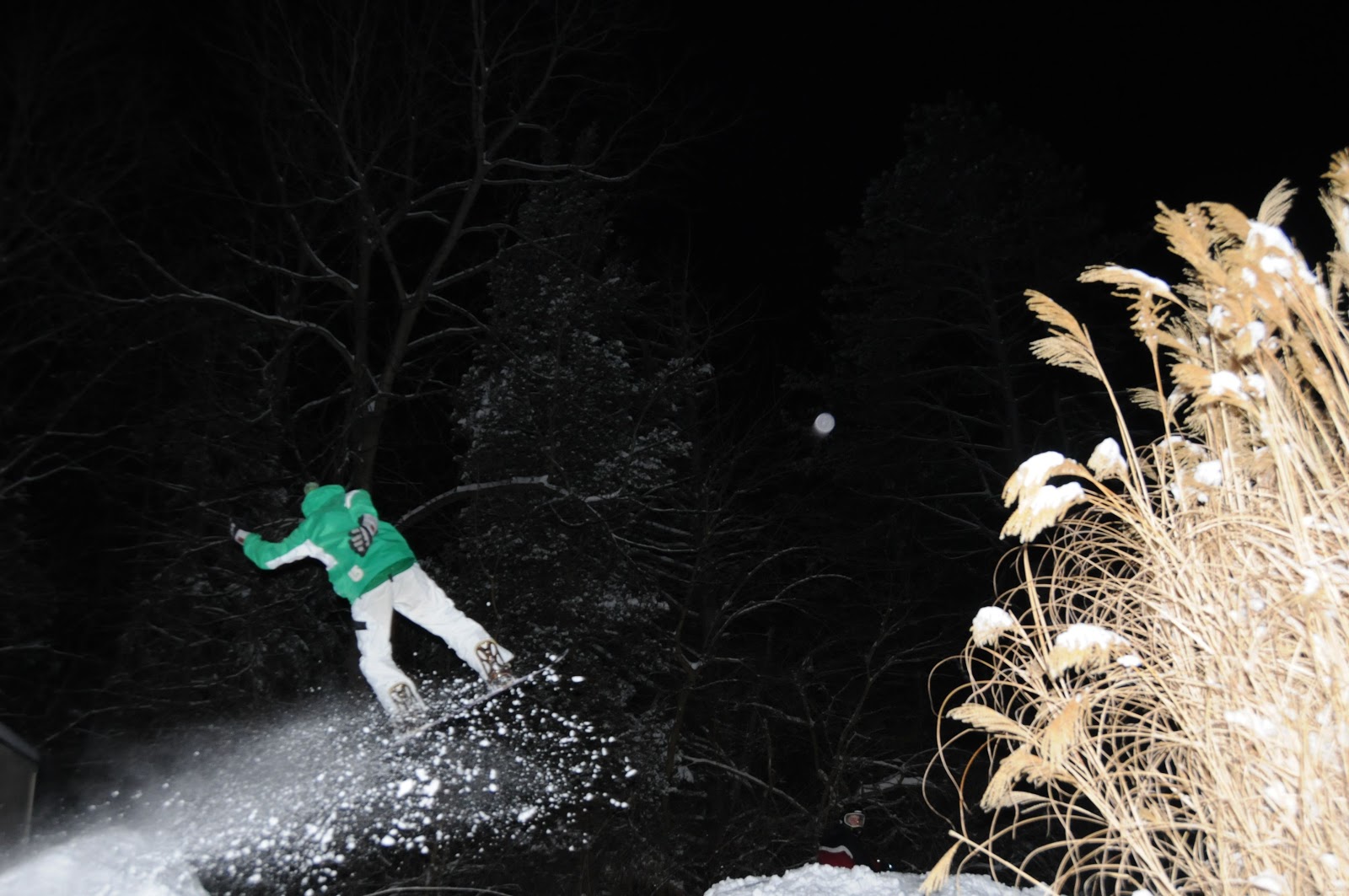
Then I added to my game by becoming the official backyard photographer on Snow Days.  All the kids came to our house to snowmobile, build jumps to ski and board off, skate, and play in the snow.  I stayed outside all day, and into the night,  capturing these youthful images for my kids to forever remember.


The following year, I made a vow to add a walk in the woods daily.  We have a neighbor who owns several acres of woods with two ponds, he allows the people who live in the area to walk the paths he keeps clear.  On one of my walks, I discovered a fireplace and majestic chimney, standing alone among the trees.  There was once a cabin that went with the chimney, but it had burned down.  I was captivated with the chimney, and walked down there frequently to sit on its hearth and watch the creatures in the woods.  I still do that.

Chimney in the Woods


My Snowy Backyard


As much as I hated to admit it, I found that my friend was right.  The more I made myself go outside during Winter, the more I came to enjoy the special surprises of this cold season.  Walking on the ice at midnight brings an unworldly kind of silence and peace.  If the temperature drops below zero, the ice cracks and pops, and the echoes of it can be heard all the way up to our house.  When it snows, I can hear each flake hitting the ground in the woods.  The air feels cleaner, colors are sharper, and I feel good.

Drummond Island Ledges
Last year, I planned to take my game to a whole new level.  I researched a trip to Drummond Island, in Lake Huron.  The possibilities were endless!  Fossil ledges accessible only by snowshoeing, a snowmobile trail across frozen Lake Huron to Canada, the icy tundra of the rare Alvar region on the island all beckoned me to challenge myself and fully experience Winter.  The unusually warm Winter of 2012 put a damper on my plans, but I went to Drummond Island anyway.  While the weather was mild and there was little snow, it still ended up being a wonderful trip because of the people and places there.  I fell in love with the island, and plan to return.

Drummond Island Alvar Region
But this year, I am going a step further in the game.  Next week, I will travel north to the shores of Lake Superior, where I will join a group of strangers to climb the icy cliffs of the Pictured Rocks.  The last several days at home we have been hit with an arctic blast of cold air, and I have forced myself to go outside each day to acclimate my body to the frigid temperatures.  The weather prediction for up north is cold, which is good, because I really don't want to trust my life to a giant icicle when it is 40 degrees outside.  I am so excited to push myself physically on this challenging quest, embrace Winter, and meet other people whose sanity is as questionable as mine.
Courtesy Google Images


As for my friend who got me started on this with a dare, I am grateful to Donna for pushing me to be a Winter person; however,  I'm pretty sure she has never been ice climbing.  Game on, indeed.

Wednesday, November 21, 2012

The End of The Story…But Not The Journey!


Even though this story is too long already, I will continue, because it's almost over, and I promised my readers I would finish it this time, so here we go…

After spending eleven hours in the wilderness, lost at times, and completely unprepared, we had finally returned to the old Airstream and settled in for the night.  However, when I turned the light off at midnight, I found that I couldn't sleep.  I could hear Debbie flipping and flopping in her bed, and I was suddenly wide awake.  Calling to the front of the tin can, I said,

"I'm wide awake."

Debbie replied,

"Bonfire?"

We jumped up, went outside, lit the torches again, stoked up the fire, and got our camp chairs out.  Rooney chose to stay in the camper, and I made hot chocolate which may or may not have had a little Peppermint Schnapps in it.  

Because we were now safely in familiar territory, we began recounting our day with a different spin on it.  Looking back, we found it to be rather hilarious.  I'm not sure if the memories we made that day were really that funny, or if the exhaustion had finally demented our minds, or if the alleged schnapps played a role, but we laughed hysterically for the next hour and a half.

During the course of this very long day, we hiked to Clark Lake, we saw Culhane Lake, we explored Crisp Point Lighthouse.  We saw bear tracks.  We walked the beach where my dog ran free.  We met an old and bitter woman, and saw a phone booth where no phone booth should be.  We searched for cell phone reception and forget about OnStar.  We never saw a snake, a bear, a moose, or a mountain lion, but we saw the effects of a recent forest fire, and walked on a bouncy bridge.  We breathed in the Two Hearted River.

It was a good day, the best kind of day, because very little went according to plan.  


We learned to throw away the plan, and let the wilderness take us down a new path.  Debbie learned to trust me again, and I learned to trust her, to trust that she is stronger than she believes.  When I finally went to bed for the second time that night, I slept deeply.  I no longer dreamt of the Two Hearted River, because it was now a living thing inside of me, the river became part of me.  I was so filled with its delicate balance that I became balanced.  It is the reason I came to the U.P. and the reason for my memorable adventure with Debbie and Rooney.  I will hold on to that memory forever!

So this is the end of the story, but…we still had a few more days to go, and trust me (you really can you know) I have new stories to tell!

Monday, November 19, 2012

You've Got Four Wheel Drive, Right? - Part 3

On the brink of discovery, Debbie and I were poised to begin the final phase of our adventure.  Having roamed the back roads of the U.P. for the last six hours with purpose but no direction, we were finally armed with clear instructions on where to go.  But first, we had to make it through Rabbit Patch Road.

Apparently, the U.P. uses the term "road" loosely.  The path that lay ahead was most definitely not a road.  I could vaguely recognize two distinct tire tracks, though they were intermittent at best.  Mostly, the path ahead looked liked a trail.  I think I would have named it Rabbit Patch Trail with a big sign at the entrance,  "Drive At Your Own Risk".

I honestly don't remember much of the drive down Rabbit Patch Road.  I think I've blocked it out to protect my sanity.  I have blurry recollections of powering the Yukon through deep sand, eyes widening at the proximity of large trees in front of my vehicle, and Debbie calling out my name.  She didn't say much else, she just used my name as a blanket warning for whatever danger was imminent.

I wish I had a picture of Rabbit Patch Road to give you a visual account, but once we started rolling we were not about to stop for photos.  I searched the internet for a photo too, but I guess nobody out there stops on Rabbit Patch Road for photos.  With both hands gripping the steering wheel tightly, steady pressure on the accelerator, and eyes focused ahead, I just kept going, wishing for the end of this road around every bend.

Finally, we shot out onto a packed sand road.  It's a good thing you never see any other vehicles when driving the back roads of the U.P., because one second we were on Rabbit Patch Road, and the next second we were perpendicular across 423.  I pointed the Yukon north, and even saw a sign for the Rainbow Lodge, which had burned down in the fire but was just up the road from the Two Hearted River.  This was it!  We were in the right place, aiming for my river!

My Memory of the Bridge. Courtesy Google Images
I was so excited.  I shared with Debbie my recollections of the brief glimpse I'd had of the Two Hearted River as a young child, the picture in my mind of a place that had so captivated me it never left my dreams.  I told her of the suspended rope bridge that I never walked across, high above the river, swaying with the weight of each footfall, weathered planks sewn together with thick nautical rope, and the same rope acting as a loose handrail.  The footbridge was so high over the river, you could get dizzy looking down!  Huge boulders dotted the water below, forming swirls in the current and shooting up drops of water that sparkle through the sunlight in the air.  It was magnificent!

My description was making Debbie a bit nervous; she was pretty sure she would not be walking over that bridge to the other side, where a pristine beach awaits, welcoming us to the shore of Lake Superior. Personally, I couldn't wait to walk over that bridge!


Courtesy Google Images
We came upon the Rainbow Lodge, or what little is left of it after the Duck Lake Fire.  Many locals had spoken to me of the Rainbow Lodge.  Located in the serious middle of nowhere, it was a dwelling with a gas pump, a store, motel, and campground.  Though a small venture, the owners stocked everything that could ever be needed out in the serious middle of nowhere.  They had canoes to rent, fishing poles, tackle, and bait.  They sold spark plugs, oil, gas, and thermal underwear to snowmobilers.    They had electric hookups and a water source for campers, and propane refill.  They were the be-all, end-all resting place for outdoorsmen (and women).  The locals are concerned because Rainbow Lodge's owners are not going to rebuild after the fire.  This could affect winter tourism all along the North Country Trail (which, incidentally, we had crossed a dozen times that day) because it was the only place for snowmobilers to refuel.  The Rainbow Lodge was an icon, and looking at the charred remains of it made me sad for the owners, the locals, and for myself, because I never got to stay there.

Rainbow Lodge after the Fire, Courtesy Google Images
The location of the Rainbow Lodge is just three short miles ahead of the Two Hearted River, and as we passed it to begin the final leg of this very long journey, I glanced back through the rearview mirror for a last look at the ruins, and it was then that I saw…it.

With a growing sense of complete and utter stupidity, I turned my eyes straight ahead and quietly spoke.

"Debbie?"  She looked at me as I continued,  "I've got OnStar".

In the silence that ensued, I could actually see Debbie putting the pieces of that simple statement together.

We were lost.  We had no cell phone signal. We couldn't access navigation.  We were lost.  We just passed the same place for the third time.  We were lost.  No cell phones.  OnStar.  Satellite.  Signal in any wide open space.  Duck Lake Fire.  No trees.  Wide open spaces.  Satellite.  OnStar.  Directions.

These thoughts went through her head quickly, and as she turned to look at me, I could see the fire in her eyes.  She said,

"Wait.  You've…got…OnStar?  Oh Kiki."

I pushed the little blue button on my rearview mirror, and a lovely voice filled the vehicle asking how she could help.  I disconnected.

This could have been a turning point in mine and Debbie's friendship.  


Though she stayed quiet, I pretty much knew what she was thinking.  We had just spent seven hungry, thirsty unprepared hours driving the same dirt roads over and over, looking for that one road that would lead us to Paradise.  She hadn't made it to the Tahquamenon Falls Brewery, she didn't have a glass of wine in her hand.  We had peed in the brush, our hair and skin were covered in dust, and Rooney was emitting an unusual odor.  We were tired, sick of being in the car, and anxious to return to camp before dark, and all this time I could have pushed that little blue button and saved us hours of searching.

All day long, even in my growing desperation to find my dream, it never occurred to me that I have OnStar.  I simply forgot.

So this could have been a turning point for us, and probably would have been, had I not at that moment turned the corner in the road that opened up to the entrance to the Two Hearted River Recreational Area.  We had arrived, and the view before us took our breath away.  No more words were spoken as we drove in to park.  Even Debbie got out of the car, drawn to what I was seeing.  Please, readers, feel free to take a moment of silence, to absorb the enormity of this pivotal moment in my life.

"The Journey to the Dream"


"Sweet" by The Dave Matthews Band Away From The World

Letting Rooney out of the backseat, I walked with purpose toward the rope bridge.  Except it wasn't a rope bridge anymore.  Still a suspension footbridge, it is now commonly called "Little Mac" with a nod to the big bridge that grants access to the U.P.   This new bridge still swayed and bounced, but had much firmer footing and an actual wood railing.  Despite its charm, I was devastated.

Debbie felt comfortable enough on this sturdier version of my memory to cross the bridge with me.  It wasn't very high, maybe 10 feet above the river.  It wasn't very long either.  And there were no boulders in the river, just a few rocks at the bottom.

It seems that the memories of a child are significantly larger than reality.

Yet we had traveled unnecessarily far today for this moment.  I was not about to hold on to my disappointment, instead I looked at the bridge and the river through the eyes of an adult, determining that Hemingway was right; the Big Two Hearted River is a spiritual renewal.  Looking out at the rivermouth and Lake Superior beyond, I felt that renewal.  Like God and Hemingway, I saw and I knew that it was good.

In this place, I was seeing nature in its purest form.  Everything worked the way it should.  In any direction I looked, I saw proof of the intricate balance of nature, the significance of it, and the power of an infinite will for life.  I saw God in the current of the river, I saw Him in the waves crashing onto the shoreline.  I felt His presence in the air around me, and I felt peace in this holy place.  Everything worked perfectly, in a way that man cannot recreate.  This was more powerful than the presence of every person who ever stood here.  This was living, breathing, moving life that cannot be fully extinguished.  The river embodied hope and faith.  It filled my spirit.


We stayed longer than we should have.  We crossed over the bridge, walked the beach on Gitche Gummi, watched some anglers heading back in the waning light of the day.  We hand-pumped drinking water, let Rooney drink from the river, and laughed at the warning signs posted for the bridge and the boat launch.


We sat on the bank of the Two Hearted River and watched the sun go down, staring out over the far bank to the powerful waters of Lake Superior.  We waved to the fishermen as they trolled past us in the river.  I said hello to the Two Hearted River, and then I said goodbye to it.

Our journey was not yet over.  We had to drive back to camp.

Chapel of the Two Hearts, Google Images
Debbie and I were both certain of our route home.  Actually, if you look at the map, which I really wish I'd had with me that day, it is a simple route.  South on 423, left on 414, right on 500, then left on the paved 123 to Tahquamenon.  When we drove past the ruins of the Rainbow Lodge again, I saw a sign for the Chapel.  If it hadn't burned down, I wanted to see it.  I asked Debbie if she would mind if I took a quick side trip.

I think at this point, Debbie's will had been broken.  Her belief that she would ever see the tin can waiting for us at the campsite was gone.  But her disillusionment had been replaced with something else.  She was learning to trust me again.  We may have been lost all day, but we saw things that she had never seen, and experienced things new to both of us, and we did eventually find my river, and by now we both knew these roads so well that she trusted me to get us where we needed to be.  I'm pretty sure she fully expected that we would sleep in the Yukon tonight, but at this point she had given herself over to our situation and simply didn't care anymore what happened.  So when I asked if I could drive down yet another dicey two track in search of something that I wasn't even sure was there, she said "Sure, why not?"

Duck Lake Fire, Google Images
The Chapel wasn't there.  I could not even find the precise location of where it had been.  We were in the heart of the Duck Lake Fire path, and everything had been obliterated.  I got out of the Yukon, asked Debbie to join me, she said no, then I walked up a steep hill to look out over the land.  In front of me was Lake Superior, behind me was a barren forest.  The loggers had not been here yet, and the trees, some with blackened pine cones still hanging from their branches, were charred.


It was getting dark, making the forest look ominous.  There was no sound at all.  The fire had taken away the habitats of every creature.  No birds called, no chipmunks scurried about, no leaves rustled, and no bugs buzzed.  There was absolute silence.  And yet, nature finds a way.  Looking closely at the ground, I saw green sprouts reaching up.  Ferns had already begun growing back.  Life goes on.  Always and everywhere, life goes on.

I made a couple of detours from 414 as well.  Debbie went with the flow.  I took a couple of two tracks in search of Moose feeding in the dusk, but saw nothing.  We approached the junction with 500, I slowed, then had to stop because we saw our first logging truck of the day, barreling toward us on 500 with a full load of black tree trunks.  Pulling out behind it, I was immediately enveloped in a cloud of dust so thick we couldn't see the truck in front of us, or the road.  Perfect.

Courtesy Google Images
We followed that logging truck all the way to 123.  Completely blind at this point, I just tried to stay in the center of the dust cloud and hope for the best.  Finally turning onto pavement, and the road home, was an iconic moment for us.  I looked at Debbie and said,

"See?  I told you I'd get us back.  Trust me!"  With a merry grin, I drove the final 20 minutes in the dark, relieved that I would soon be brewing a pot of coffee and building a fire.
Junction of County Road 500 and M-123 during the Duck Lake Fire.  Google Images

The campsite was a welcome sight, though very, very dark.  I lit the torches and unlocked the tin can, started the coffee brewing, fed Rooney real dog food, for which his digestive system was most grateful, gave him a bowl of water, gave him another bowl of water as soon as he finished the first one, and grabbed my stuff - what little I had - from the car.  Debbie started a fire.  Yes, Debbie actually started a fire, (she's getting really good at it!) while I grabbed all the fancy food she had brought and carried it out by the fire.  With a glass of wine in Debbie's hand and a cup of coffee in mine, we sat down by a roaring fire and devoured cold egg quiches and cold veggies and cold pasta.  It was 10:00pm, and we were too tired to talk.

Exhausted, we left the fire shortly after and prepared to sleep.  Once we were blissfully settled in our beds I grabbed a notepad and pen, and started writing down all the things I wanted to remember from our trip thus far.  I called out to Debbie, who was in the front bed, asking her what things she remembered.  We yelled back and forth for a while until we thought we had everything captured on paper, then turned out the lights.

It was midnight.  You'd think this is the end of my story.  But once again, you'd be wrong!

So with a thousand apologies to my biggest fan, Jo, I must end this for now because the kids are about to come home.  I will finish the story tomorrow…trust me!