Peace In A Tin Can

Peace In A Tin Can
Showing posts with label wilderness. Show all posts

Thursday, January 28, 2016

The Roadtrek Winter Freezeout Mantra: No Bugs, But Cold Seats In The Pit Toilet

People say I am crazy.  When I tell friends and acquaintances in my hometown I am going camping in Michigan's Upper Peninsula in the winter, they shake their heads and look at me like I am not quite right in my head.  Won't it be cold?  What about wild animals?  What if your truck gets stuck in a snowstorm?  They express all kinds of worries, letting their imaginations and fears get the best of them.  It's really no big deal to go, but it is a big deal to be there.

I have been hearing this sentiment for years, longing to meet people who are more like me, with the same interests, passions, and desire to experience nature.  A few years ago, I stumbled across a blog by Mike Wendland,  Roadtreking:Discovering the Small Motorhome Lifestyle.  This guy, and his wife, Jennifer, travel around the country in a Class B Roadtrek motorhome, a big van really, and see things most people don't see, meet interesting road warriors who do the same, exchange stories and experiences, and teach the rest of us how it is done.  I began following his blog, listening to his
podcasts, subscribed to his newsletter, and eventually began an online interaction with Mike.  Most of his group are Roadtrek owners, they go to rallies together, have smaller meet-ups, and wave to each other on the road.  I was delighted when Mike said I could join a Roadtrek outing in Winter 2015, even though I would be camping in my car, at Tahquamenon Falls.  I had a great time playing in the snow with a small group of adventurous souls who took good care of me, bringing me coffee in the morning and checking to make sure I hadn't frozen to death in my car.

This year, our group grew, as did my camping accommodations.
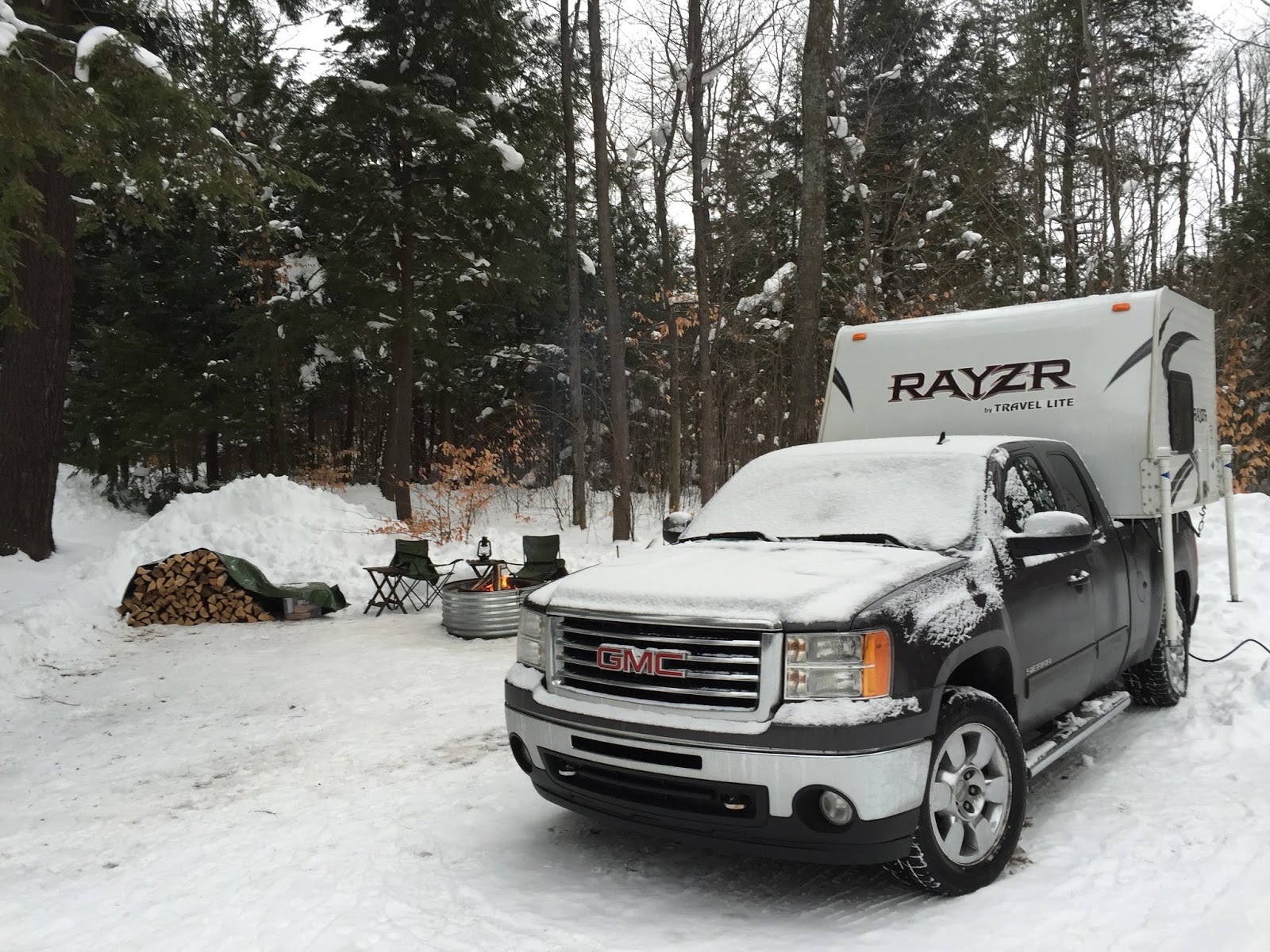
We had about 50 people arrive in our winter wonderland as I greeted them from my truck camper.  Still not as convenient as a Roadtrek, but a definite step up in comfort from last year.  The park staff at Tahquamenon Falls State Park are top-notch and had plowed additional sites out for us, brought us snow shoes to borrow, and a bucket of sand in case anyone got stuck in a snowbank, which one of us who shall remain nameless ended up using.  The outhouses were clean and well-stocked with toilet paper. (You'd be surprised how pleased we all were by that).  Our weekend began with happy reunions and getting to know the newbies.  I was so happy to be there my face froze in a great big smile.
Road treks parked at
The Inn in Paradise.
Photo Credit: Ari Adler

Yoopers - people who live in the U.P. of Michigan - call the land above the bridge "God's Country".  Indeed, it is.  They even have signs posted along the road, to remind drivers they have no worries, they are in God's Country.  The Roadtrek Band of Merry Men and Women embraced it, got out in it, breathed it in, let it fill them, and became part of it.  Collectively, we snowshoed to the lower Tahquamenon Falls with Theresa Neil, Michigan DNR Interpreter, then a small group took the challenging  route to the upper Falls, a strenuous 8 mile hike wearing snowshoes designed to keep your feet on top of the snow but aren't that effective on the steep up-and-downhill terrain.  Some went to the dogsled races, while others explored Whitefish Bay with Lake Superior waves frozen mid-curl, where time stands still and the winds do not.  Mike set up his HAM radio at the upper Falls, on a section of the North Country Trail to participate in the National Parks on the Air. You can read all about it here. Photographers broke trail and captured places where no man had walked since the freshest snowfall.  I drove to a parking lot, left my vehicle, and spent two hours of solitary hiking on the North Country Trail while waiting to give a ride to that small group of hearty snowshoers making their long journey to the upper Falls.  They were unusually happy to see me at the end.


Photo Credit: Yan Seiner

Photo Credit: Yan Seiner


Photo Credit: Ari Adler

Photo Credit: Lynn Ellen Kaiser


Habushu: The Essence of Snake
We spent most of our time outside, some of it in remote areas.  We weren't cold, because we were moving and dressed for the weather.  We weren't miserable, or isolated, or hungry or thirsty.  We were alive!  At night, we built a bonfire and sat around its warmth.  Some of us supplied a little bit of our own warmth.  Yan even brought Habushu, but that is an entire story in itself which I will tell later.  Tired from our day spent exploring outside, we enjoyed good conversation, Gouda cheese, a warm fire, and stories of our travels.


Photo Credit: Jim Diepenbruck
Roadtrekers aren't crazy, but they are my kind of people.  They had come from Michigan, Ohio, Minnesota, Wisconsin, Pennsylvania, Illinois, Indiana, and Ontario, Canada.  They have traveled through Canada to Alaska, from Maine to the Outer Banks to the Florida Keys, from Texas to New Mexico and Arizona.  They have boondocked at Yellowstone, Glacier National Park, and along the Pacific shores in Oregon and California. They have been to the Heartland and made it part of their own heart.  Jim, a photographer in our group, boondocked in an extremely isolated wilderness on the way to and from the U.P., looking for Elk.  He didn't find any, but Jim did get a fleeting look at the Coyote who was none too please to have Jim as a guest in his home, and expressed the sentiment late at night while Jim was outside photographing the stars.  Jim's not crazy, but he experienced something most people never will, a close encounter with a wild animal late at night, and shared a moment with a Coyote, a moment he won't forget.  That Coyote is part of Jim's journey now.

I have turned my dream of owning a Roadtrek into a goal.  I have no idea yet how I can make it happen, but I can open a conversation with my husband about his retirement in a few years.  Together, we can decide what we can live without (you'd be surprised what you can live without), what we can give up, and what we can gain by traveling the country together and immersing ourselves in the adventure of living.

I want what these people have.  They have worked hard, raised families, overcome tragedies and health issues, have faced the challenges we all face.  Some are still facing them, still working, still planning.  But they all know this very important secret:  whatever came before today is over.  Whatever will come tomorrow is unknown.  So take today as the gift that God gave you, go out, and explore.  Fill your soul with a spirit of adventure!  Embrace the mantra of our Winter Freezeout; No bugs (the perks) and a very cold seat in the pit toilet (little inconveniences that don't matter).  Wherever you are right now, in your home, in your office, out shopping, or camping in two feet of snow...there are perks and minor inconveniences.  We are not crazy.  We are fun and full of life.

Photo Credit: Yan Seiner


If you still think we are crazy, watch this video by Roadtreker Ari Adler:


To be on the edge of a cold wind and a warm sun, and watch the melding of water and ice; to stand where there are no footprints and breathe; it is the igniting of imagination, the freefall of spirit, and the stillness of your soul.  But it's not crazy


I am grateful for my time with the Roadtrekers in a winter wonderland.  I love their stories, their warmth, their laughter, and their willingness to explore.  I love their sense of humor.  I love them. Most of all, I love being in God's Country with them.  No big deal to go, but a really big deal to be there.  Crazy, eh?


Friday, November 8, 2013

Porcupine Mountains Series: Some Final Thoughts

As far as mountains go, the Porkies are not very big.  They are nothing like the Rockies, or the Tetons, or K2, Denali, and Everest.  But they are older than all of those other mountains; in fact, they are the oldest mountains in North America, and the second oldest in the world.  The Porcupine Mountains also have a rich history, and many other distinguishing characteristics.

Despite my excitement to explore the mountains upon my arrival, I first stopped at the Visitors Center.  The Michigan Department of Natural Resources has an excellent reputation for providing information and helpful tips for visiting any of the state parks, and I found this center to be particularly helpful in understanding what I had gotten myself into this time.  Mounted boards told the story of the Porkies, and I greedily read each one, absorbing as much information as I could to enhance my hiking.

Over a billion - yes, I said billion - years ago, far below the surface of the earth, the crust began to shift and pull apart, or "rift".  The bedrock of the Porcupine Mountains belongs to the Keweenawan Supergroup, a thick sequence of volcanic and sedimentary rock deposited throughout the rifts.  As the mid-continental drift was developing across Michigan, and as far south as Kansas, volcanic eruptions continued over millions of years.  Some 40 million years after the first rift rocks were deposited, shifting tectonic plates uplifted areas along the rift, forming the Porcupine Mountains.  In the past several million years, the mountains have been eroded flat, and pushed up again, several times!

In other places in the world, these rift rocks lie buried, but in the Lake Superior region, they are exposed.  Over 40,000 years ago, glacial movement carved out the Great Lakes, and deposited sediment to the area to give birth to the shape, flora and fauna of the Porcupine Mountains.

This is all fascinating scientific information, almost incomprehensible, but it's not what I thought about while hiking.

Google Images
Even though the Porcupine Mountains are very old, they are easier to access than other mountain ranges.  You don't need any fancy equipment, or permits to climb.  You won't have to fix any lines, or belay, or hang from a cliff in a tent at night.  You don't even need a particularly adventurous spirit.  If you can walk, you can hike the Porkies.  It helps to
be a somewhat active person, but even if you are not, you can see some of the grandeur by walking.  But if you want to experience all that the mountains are, its best to hike and immerse yourself in the environment.

P.J. Hoffmaster, Google Images
I am very fortunate to be able to do this, and to live in a State that recognized the importance of preserving these mountains for all of us to enjoy.  People like P.J. Hoffmaster, Raymond Torrey, W.C. Edens, Governors Harry Kelly and George Romney, and the fine people of Michigan's DNR were responsible for acknowledging and

Governor George Romney
Google Images
protecting the natural and historical significance of the Porcupine Mountains Wilderness State Park.  But I wasn't really thinking about them either, as I continued to hike up and up the Escarpment Trail, until I became a solitary figure standing at the top.

I climbed a mountain.  I didn't need picks and ropes, or a partner to climb with.  I had a day-pack on my back with water, granola bars, and a basic first aid kit.  I had a small camera and a knife in my pocket.  My dog climbed with me.  After a half day of hiking, I stood on top of a mountain, and looked out over Lake of the Clouds, and realized I was standing on rock that formed over a billion years ago.  But I wasn't really thinking about science and rifts and volcanos and glaciers.  I was wondering about the other explanation for the birth of the world; I was thinking about God.

In the Bible, the book of Genesis has God creating the world in 6 days.  We know that's not true, at least not in the way we understand time.  So I asked my favorite Priest, Fr. Geoff Rose, about science and creation.  He explained that those who wrote Genesis were not trying to give an historical and scientific explanation of earth, they were sharing their experience of God.  For Fr. Rose personally, he sees the "four billion years of the universe as proof of how awesome and intricate creation is, and how patient God is with creation".

I often hear people say standing among the mountains reminds them of how insignificant their lives are; they lose themselves to nature, allowing it to lessen their petty worries and let the vastness and complicated balance of nature bring them peace.  When I stood at the top of the mountain, I understood that, to science, I am insignificant.  I am a tiny, tiny speck in the world, unseen and unknown.  But to God, I am huge.  I matter.  I can make a difference.  Like the mountains, I can teach, and bring balance, and be beautiful.  I can be grounded flat and rise up again.  I can turn my worries over to my faith, and be like the mountain, strong, living, giving, and balanced.


That's what I thought about on the mountain.  I didn't feel small; I felt empowered and inspired to go home and do more.  Love more.  Be more.  God created me, and placed His faith in me to do what I can to make the world a little bit better.   I will try, and sometimes fail, to live up to God's promise for me, knowing that He will be patient with me, His creation.

I had the distinct thought that I was lying in the hands of God.  Later that day, when I returned to the tin can, I came upon a centuries-old tree stump that Lake Superior had carried to shore from some distant place.  It looked like a hand, turned up, waiting to cradle me, and I smiled.  I had gotten a wink and a nod from the Big Guy, and I knew that I was where I was supposed to be.


I climbed a mountain.  I will climb many more, always knowing that when I stand on top and look out over the vastness, I am not a tiny speck.  I am significant.  I am huge!


Friday, October 25, 2013

The Porcupine Mountains Series Part 3: We All Need Something To Hang On To

burberry.com
Boots.  Tall, rubber, waterproof boots.  That was what I needed.

About three years ago, I saw a picture of my beautiful and very fashionable niece wearing a pair of Burberry boots at a tailgate party.  I was fascinated with her boots.  They looked so…safe.

muckboots.com
Then last summer my nephew, who had been pouring concrete, dropped by my house wearing tall rubber Muck boots.  I kept staring at his feet, thinking they looked so safe.

Do you ever get an idea in your head that has no basis for credibility but you believe it anyway?  You believe it because you have to?  This is what happened to me with the tall rubber boots.  I got this idea in my head that if I wore tall rubber boots, the snakes couldn't get me.  I came to believe that if I wore those boots while hiking, the appearance of a reptile with no legs would not throw me into a complete panic, because my boots would protect me.  Snakes can't suddenly cross over your foot and climb up your pant leg when you're wearing tall rubber boots.  They can't strike at you through thick rubber.  The boots would keep me safe.  I believed it, I needed that thought to hold onto, and I knew I would never experience a completely peaceful hike without those boots.

But the boots are not cheap, and since I am always stockpiling my money for gas to take my trips to the U.P. of Michigan, boots were not in the budget.  At least, not until my compassionate husband surprised me with a pair of Hunter boots, complete with fleece liners.  They…are…awesome, as is my husband.

Armed with my tall rubber boots, I headed into the Porcupine Mountains with confidence.

Since I spent my first day in the mountains not hiking while I dealt with a shredded tire on the tin can, I had ample opportunity to meet other hikers in the campground.  Asking each of them where they had hiked so far was always accompanied with an inquiry into the snake population out there on the trails.  The 4 Guys had hiked the entire 17 miles of the Lake Superior Trail in one day, and saw two snakes.  The hunter had just emerged from several days of backcountry camping; he saw lots of snakes.  When I asked the couple next to me if they saw any snakes on the Presque Isle trails, they casually replied "oh, just a few".

The freakishly warm weather in October was keeping the snakes of the Porkies active.  No worries; I had my boots.

The next morning, after the sudden storm of the night before, I walked Rooney early.  Wearing my Hunter boots, I headed up the drive through the campground to a field where Rooney could sniff all the bushes.  Along the way, there was a short stretch of road that had deep brush on either side, with tall grasses and wild flowers.  As I strolled through this wild alley, I saw something on the ground.  Upon
closer inspection, I realized it was a snake, which had come out of the weeds seeking the heat of the asphalt after the storm, only to be flattened by a late night arrival of an RV to the campground.  I'll be honest; my heart did that little skip-a-beat thing it does, but I stayed calm.  I had my boots to protect me in the unlikely event that the early morning sunshine would breathe life back into the flat snake.  I kept going, with even breaths and a new-found confidence.

However, stepping foot on the Presque Isle trail gave me pause.  I mean, these snakes would be alive.  I pulled myself up by my boot straps - quite literally - and hiked with confidence.  Over the next several days I hiked many miles on
many trails.  The only time I took my boots off was when I went to bed each night.  They were comfortable, kept my feet dry in muddy areas, and warm.  Most important, my boots removed my fear.  I didn't want to see a snake, but I didn't worry about it either.
Google Images

The funny thing is, I never saw a single snake, except for the dead one in the drive of the campground. I think I am the only hiker that was in the Porcupine Mountains that week who never came across a snake, which leads me to believe my boots have magical powers.  They don't just protect me from snakes, they scare them away!  Hey, we all need something to hang on to.


I love my Hunter boots, and I love my husband for getting them for me.  Next year, I might even hike the Cedar Swamps.  Okay, no I won't.  I may be crazy, but I'm not stupid!

Cedar Swamp, Porcupine Mountains
Courtesy of Google Images

Tuesday, October 22, 2013

The Porcupine Mountains Series Part 1: Hallowed Hollow Ground

I like trees.  This is a bit of an ongoing argument at my house, because Scuba likes to cut down trees.  I understand his concern with things like pine needles and leaves clogging eaves troughs, and roots
infringing on the driveway.  However, I always point out the trees were here first, so I win.

If I could get Scuba to take a day-long hike through the Porcupine Mountains, I might be able to change his way of thinking.  A long time ago, before settlers arrived in Michigan, Wisconsin, and Minnesota, those lands contained 81 million acres of undisturbed, closed-canopy forest.  About half of this land consisted of forests of sugar maple, eastern hemlock, yellow birch, American basswood, northern red oak, and eastern white pine.  Today, less than 0.2% of these hardwood-hemlock forests survive as virgin (never been logged) forests.  The largest of these virgin forests is in the Porcupine Mountains, with 35,000 acres of relatively undisturbed hardwoods and hemlocks.*

I only saw a fraction of that while hiking the Porkies, but it is really something to see.


It's not that portions of the Porcupine Wilderness has never been logged.  In the late 1800's, tracts of land were purchased to log the white pine and cedar stands.  Sadly, remnants of the logging era still remain today, where century-old pine stumps can be seen all along the Lake Superior shoreline.*  But the difficulties of logging in this wilderness area pushed the logging barons to other places by the early 1900's.  As technology advanced, some logging activity took place until the early 1940's.  The last logging operations in the Porcupine Mountains occurred in 1953-1954, after a wind storm left a blowdown of centuries-old trees between the mouth of the Big Carp River and Summit Peak.  After the storm, park officials contracted with Connor Lumber and Land Company to salvage the timber in exchange for land the park wanted.  When the salvage of the timber was complete in 1954, the Michigan Conservation Commission declared the Porcupine Mountains a Nature Reserve, thereby protecting the remaining virgin stands from further logging.*

Darkness in Daylight
My favorite tree is the Hemlock.  When hiking on Government Peak trail to the top of a
mountain is halted by a majestic 400 year old tree, I can't just walk around it.  I must take a moment to study its solidity, its gnarled roots visible below my feet, yet stretching deep into the mountain rock for stability.  Standing under its branches, I am awed by the darkness at the height of day, the mighty Hemlock blocking the warmth of the sun, yet radiating its own heat down on the earth.  I am humbled by its strength, inspired by its endurance, and joyful at its beauty.

As I hiked, I noticed from time to time my footsteps made a hollow sound, like I was walking on a drum, and I wondered about it.
Later, a visit with Bob Wild of the DNR shed some light on this phenomenon.  The mountains are a result of millions of years of volcanic eruptions and tetonic plates moving around, and have a strong foundation of rock.  The Hemlocks traveled through pollination and took root in the glacial deposits and rock, but the roots necessarily grow down through the earth.  In various places, especially where the virgin Hemlocks stand, the root formations under the rock have created pockets of air, or hollow places.  At first I found this unsettling, but Bob explained that the roots serve to strengthen the framework under the ground.  He pointed out that the "hollow" ground on which I walked felt very hard and solid.  As my time progressed in the mountains, I came to think of these areas as walking on hallowed, hollow ground.  Bob liked my description.

Those same roots, exposed above the crust of the mountain, act like fingers, reaching out to claw and grab.  It is entirely possible that a lone hiker could find herself having some difficulty navigating the Hemlock roots, which brings up the age old question; if a hiker stumbles and trips her way up (and occasionally, back down) a trail, but no one is there to see it, did it really happen?  So I found myself being quick and light of foot, following in the steps of my American Indian ancestors with speed and agility on my hike.  That's my story, and I'm sticking to it.

The entire 7.3 mile hike up Government Trail was made worth it by the rest stop I took at Trap Falls.  Stumbling…um, I mean, gracefully stepping, into a designated backcountry campsite, complete with a bear pole, and finding a rustic outpost of the most delightful design, was a much welcome respite from the hike.  Many others who had traveled this way before me had created an outdoor home complete with chairs, tables, fire pit, and the soothing sound of Trap Falls cascading into the Carp River.

Rooney ran down the steep bank to drink from the cool, clear water, while I sat on a log and drank my bottled water.  I looked up, at the mighty Hemlocks.  I looked over, at the bear pole where countless hikers have hung their food.  I looked around, at the natural impression in the mountain that gives a small but flat place to set up camp.  I looked down, at the water flowing over and around ancient rocks, and I thought "God is good, and Michigan's DNR is awesome."

I stayed longer than I should have, but found it difficult to leave this magical speck of earth.  As I climbed up the steep bank back to the trail, a Hemlock branch was there to give me a hand up.  In gratitude, I saluted the tree, and envied its post.  To be a sentinel over this beautiful mountain, and this very spot where people seek shelter, is a duty that can only be given by God.

Eastern Hemlock can be found throughout the park.  They can live 500 years or more, and reach 100 feet in height.


Arriving here from the eastern Allegheny forests 3,000 years ago, their thick canopy of needles provides not just shade from the sun, but shelter in the winter, attracting deer in the snowy months.  Hemlock stands become deer yards during the winter, where the deer feed on buds and needles.  The tannins in the needles and bark of the Hemlocks also creates the reddish-brown color of the streams and rivers in the park through runoff.*  All through my hike up to Government Peak, I marveled at the Hemlocks, seeing the effects of them everywhere I looked.  They are a living, dynamic presence which urged me to keep going, even as I tired.

Root growing over Rock
I found a sense of inspiration in the woods.  The Hemlock will not be daunted, giving me the idea that the next time someone challenges me to a game of Rock, Paper, Scissors, I want to be a Tree!

Throughout my hikes up the mountains, I forged ahead, I reached the top, and I came back down.  I followed the rules, carrying out my empty water bottles and granola bar wrappers.  Because God has given us this amazing place, but the DNR, hikers, and nature lovers are bestowed with the responsibility of keeping it amazing, I was careful not to disturb the balance or leave anything but footprints, and possibly a little bit of flesh and blood from my leg, but that's a story for another time.  I hope that someday, my husband will walk the mountains with me, and see what I've seen, and never cut down another healthy tree again.  Then again, he usually cuts them down when I'm not home, so if I'm not there to see the tree fall, did he really fell the tree?  That's his story, and he's sticking to it.


*All of the historical and environmental information in this post comes from The Last Porcupine Mountains Companion, Fifth Edition, by Michael Rafferty and Robert Sprague, published by Nequaker Natural History Associates, 2012.   I strongly recommend reading this book prior to a visit to the Porcupine Mountains.  It will not only give you helpful tips for exploring the park, but will also enhance your understanding of what you will experience here.

Friday, February 8, 2013

What Makes You Different?

Courtesy www.openwalls.com
As I spent last weekend trying to take in all the new people, places, and experiences at Michigan Ice Fest, one burning question was on my mind.  When I told friends and acquaintances I would be traveling to Michigan's U.P. to go ice climbing, they all asked "Are you crazy?"  After my experience at the Ice Fest, I have to say maybe I am a little bit crazy.

It seemed to be the theme of the weekend.  But still, I looked at all my new companions, from the people who were there for the first time to the ones who go back year after year to the professional alpinists, and wondered what it is about them that makes them want to climb the ice.

This group of people didn't seem to realize that 99% of people simply don't want to climb…anything. So to the members of this select group, I posed the question all weekend.  When most people would be terrified to do what you do, what makes you different?  Why do you do this?

I first asked this question of my unexpected climbing partners on Thursday.  I hadn't planned on attempting my first climb until Saturday in the Women's Intro to Ice Class, but I met a man named Bob at the motel who said he had enough extra equipment to take me out to the ice formations.  All I needed was climbing boots.  Right away, I felt some apprehension, because I didn't even know that I needed "special" boots.  I walked over to Sydney's, the bar-slash-official headquarters of Ice Fest, and met Nic, who works at Down Wind Sports and is one of the many people who aided me in my quest for knowledge.

Courtesy www.salewa.us
The first thing I asked Nic was, can I trust this guy?  I am a woman traveling alone, attempting to do something I've never done before that holds inherent risk, and I'm considering trusting a stranger to keep death at bay while I dangle from a tower of ice.  Nic gave me some great information about safety, and even showed me what to inspect on the borrowed equipment.  He then suggested a few questions I should ask Bob, and if he gave the correct answers, I should be able to trust that Bob knows what he is doing.

I was fitted in a pair of demo boots by Nic.  They were pretty cool boots.  Made by Salewa, the Pro Gaitor Mountaineering Boot has many critical features that I came to appreciate as the day went on.  They were warm and stayed dry, but have a breathable membrane so my feet didn't sweat.  The grippy Vibram Salewa Pro outsole gives a good grip in snow without strapping on a crampon.  And the best feature of all is the adjustable tension system which allows you to switch between walking and climbing mode with a twist of the included allen wrench.  Usually, wearing a pair of rented boots would lead to blisters and swollen toes, but these boots were so comfortable and warm, I forgot I had them on.

Armed with boots and advice from Nic, I went back to the motel and knocked on Bob's door.  He introduced me to his climbing partner, Francesco from Rome, Italy, and after some time spent adjusting gear and packing up my back pack, we left in my Yukon to find some ice!

Again, this was all new to me.  I didn't know that we had to drive to the parking area at the end of Sand Point Road, leave our vehicle, and walk most of the way back down the road, find an access point, and hike up a steep incline.  I was exhausted before we even reached the ice!  I was so focused on putting one foot in front of the other, that when I glanced up to finally see the ice in front of me, it took my breath away.

I had to wait, a rather long time, while Bob found the higher access point and hiked above the falls to place the top rope.  I kept my feet moving to stay warm, and when Bob finally came back down, helped me into my harness, and told me to start climbing, I panicked.  Just like that?  Start climbing?  What do I do?


Bob on Belay
Bob said that when my ice pick was firmly grounded, I would know by the sound the ice makes.  Huh?  What on earth does that mean?  But this was what I came here to do, so I strapped on my crampons, grabbed my picks, and started climbing.

I didn't get far.  I was exhausted from the horrendous drive the day before, I'd had little sleep, I'd already put a few miles in just getting here, and my arms were shaking from fatigue.  No worries though, because the first time my pick hit the ice and stuck, I heard it.  A light dawned in me and I realized this is what I came for; all thoughts left my head, it was just me and the tower of ice in front of me, talking to me, breathing on me, keeping the promise to stay motionless in its intended purpose.  I trusted the sounds, the feel, and the ice.  It was that moment of me being one with this natural wonder I clung to, knowing I was part of the ice and it was part of me.  Crazy?  No.  Just right.

I began to answer my own question in that moment.  What makes me different?  The answer doesn't come from words, it comes from a feeling of being part of nature, understanding the world around me that God made.  I felt the ice, and it was all good.

I asked Bob to belay me back down.  He said I did okay for my first try.  I wasn't embarrassed that I didn't go all the way to the top, however I was determined to get some rest and push myself to go much farther the next time.  I was already hooked; ice climbing is like nothing I've ever done before, and I wanted more.

Francesco
While Bob and Francesco completed their own climbs, I hiked back to the Yukon alone.  I needed time to absorb what I had learned and done and felt.  When I finally reached the car, I planned on sitting in it with the heat running until Bob and Francesco returned; I was too restless.  Even though the wind was at gale force coming off Lake Superior, and it was 4 degrees F, and the falling snow was almost horizontal, I started hiking.  I hiked for an hour, thinking of nothing but the sound that pick made in the ice, and arrived back at the Yukon just as my partners were coming down the road.
My First Climbing Partners
Francesco and Bob


Later that evening at Sydney's, I experienced my first of several slideshow presentations from some of the most experienced and respected climbers in the world.  This became something I eagerly looked forward to each night!

I had introduced myself to the organizer of Ice Fest, Bill Thompson, and he graciously pointed me in the direction of all the people he thought had stories to tell.  Through him, I met so many amazing people!  First I met Mary, who until a year ago was in a wheelchair, a victim of Cushing's Syndrome.  Her bones had weakened to the point she had fractured her spine.  After several years of misdiagnosis and poor treatment, she met a doctor determined to help her.  One night, as Mary slept in her hospital bed, she dreamt of a voice telling her she would be okay.  When she woke, her newest doctor was sitting at her side, holding her hand, and when he spoke, she realized his was the voice she heard in her dream.  He had stayed by her side all night, praying for her recovery.  Within weeks, she was walking with a walker, then a cane, then on her own.  She is now strong enough to attempt ice climbing.  She knows in her heart that the doctor's prayers cured her, and she is determined to embrace life and new challenges.  She had climbed the ice that day and was feeling on top of the world!

I also met Rachael, a 12 year old girl who was attending the Michigan Ice Fest as the recipient of the Sue Nott Scholarship (more on that later).  Bill helped me set up an interview with Rachael and her mother.  Rachael is a delightful young lady who claims to not be a winter person, which gave me a laugh.  I asked her why she applied for a scholarship to climb ice if she hates winter.  She told me she is a rock climber who is looking for a new challenge.  In her words, ice climbing is a scary concept, but her first attempt was "epic" and changed her life.  Rachael, at such a young age, already understands the power of pushing herself to embrace nature, and she is an extraordinary girl.  When I asked Rachael what makes her different from other girls, she grinned and said "I like to challenge myself outdoors".


Then came the first presentation, by Bill Thompson.  In case there is any doubt, it really was accompanied by the best music out there!  After slides of previous years' Ice Fest antics, Bill gave an overview of the weekend and with great excitement, announced the release of the Third Edition of An Ice Climber's Guide to Munising, Michigan, which he co-wrote with Jon Jugenheimer.  This beautiful and informative guide is a far cry from the First Edition, which was typed on a single piece of paper by Mark Reisch in November 1990.  The guide is not only invaluable to ice climbers, but anyone interested in exploring Pictured Rocks National Park should purchase one here.

Bill also announced, with great enthusiasm, that the Michigan Ice Fest has grown to be an INTERNATIONAL event!  He called out to climbers in the room from France, Italy, Australia, England, and Iran.  Yes, Iran. There were Canadians there, too, but Bill doesn't count those people as foreigners, since the U.P. and Canada are essentially the same place.


Ben Erdmann
Courtesy www.downwindsports.com

Then Bill introduced Ben Erdmann.  I had no idea who he is, or what to expect, but as soon as I heard he lives in Alaska, my ears perked up.  Alaska is the dream, the top item on the tick list.  For those of you who aren't in the know, as I now am, the tick list is a list of places you've been to that were on your list of places to go, or more specifically, climbs you've accomplished.  Once you complete a certain climb, you tick it on your list.

Denali
Courtesy Google Images

I am planning a trip to hike in the wilds of Alaska four years from now.  When Ben Erdmann showed a slide of his home in Alaska, my heart swelled with longing.  He lives in my dream home, a tiny stone cabin that "would fit in most people's living room", surrounded by woods in the middle of nowhere.


Courtesy Google Images
Ben introduced himself as a native of Marquette, Michigan who now lives in Alaska, working for a conservation organization inspecting the BP Oil Pipeline.  He works in between climbing expeditions, but his job consists of hanging on the ropes over the massive pipeline, so whether he's working or climbing, he's on belay and loving it!  Ben gave a great presentation about his many climbing adventures, and spoke of his one true unrequited love with bush pilots.  Ben thinks bush pilots are the greatest people on the face of the earth, and whenever he can save enough cash, he reignites his passion for them.  Apparently, being flown in to base camp beats hiking in every time.


Courtesy Google Images
Climbing is dependent on the weather, especially on the bigger mountains in remote regions of the world.  Ben told tales of waiting for days in the village of the Patagonia Andes, checking weather charts daily waiting to climb Fitz Roy.  In Ben's words, it's not like the Weather Channel, where a picture of a smiling sun tells you it's a go; the climbers check all sources of weather related charts and must interpret them.  When the window opens up, the rush begins to pack everything up and head out.

Courtesy Google Images
Patagonia experiences very strong winds from the North and West, carried off the Pacific Ocean.  These winds create winter conditions in the western Andes year-round.  Predicting the window of weather suitable for climbing to the summit is tricky business.  Often, a climbing team begins an ascent, only to be forced to bivi up for several days under harsh weather conditions before continuing.

Listening to Ben's stories, I heard many people in the room mutter "that's crazy!"  But later, when I asked Ben what makes him different, why does he live this way, he replied he doesn't know.  He said he's just always known he wanted to do this.  Is he crazy?  No, because all climbers try to take every precaution before and during a climb.  They gather the beta, they analyze, they make informed decisions.  There is risk; but there is also skill, and knowledge, and respect for the conditions.

By the time I went to bed Thursday night, I did not have a clear answer to my question.  What makes climbers different?  I had a feeling, but could not put words to it.  All I knew at that point was, I was part of something very special, and I couldn't wait for tomorrow!
Storm Approaching, Mount Fitz Roy, Patagonia
Courtesy www.flickr.com